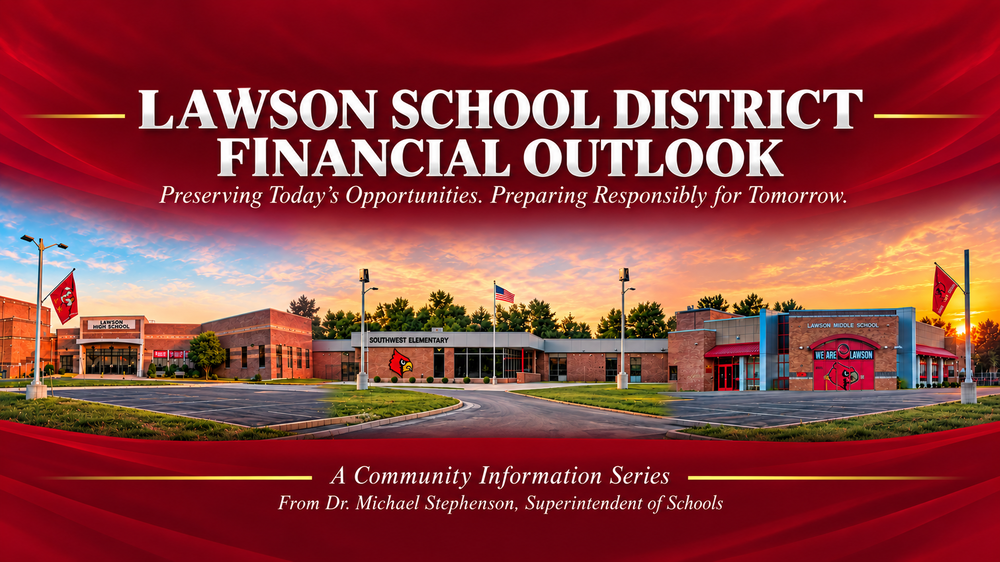
Installment 2: Building Today, Preparing for Tomorrow
In the first installment of this series, Our Financial Foundation, I shared that the Lawson School District remains financially stable because of years of responsible planning and careful management of district resources.
Financial responsibility, however, is not measured only by the amount of money a district holds in reserve. It is also measured by how effectively those resources are used to meet current needs, create opportunities for students, and prepare for the future.
Lawson has not built its financial position by standing still or postponing important needs. We have strengthened our reserves while making purposeful investments in students, employees, facilities, and the future of the district.
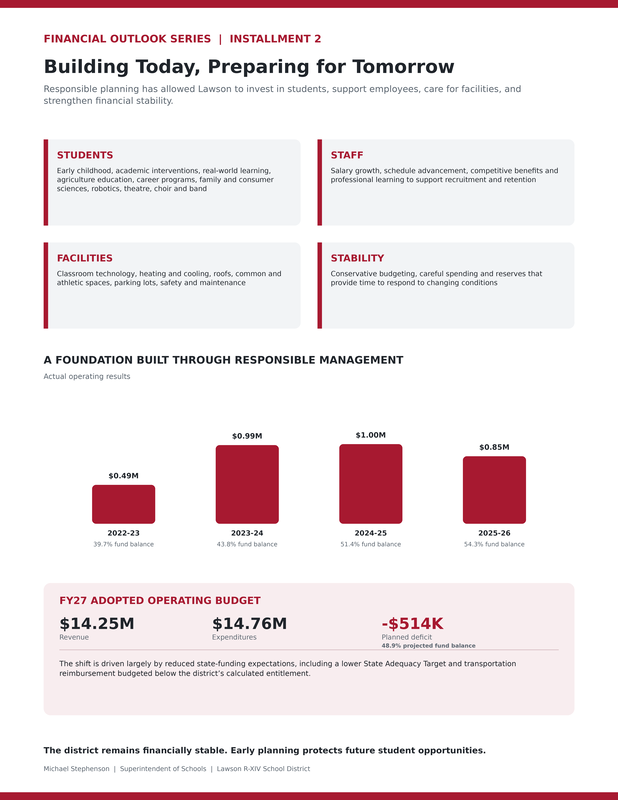
Instruction and student opportunity have remained at the center of that work. Since 2022–23, we have expanded early childhood services, strengthened academic interventions, and invested in curriculum and professional development. We have also strengthened real-world learning and career-focused opportunities throughout the district, including agriculture education, career programs, family and consumer science, robotics, and Northland CAPS, while continuing to support strong fine arts programs in theatre, choir, and band.
Supporting the people who serve our students has been equally important. The district has provided continued salary growth, salary-schedule advancement, competitive benefits, and professional learning opportunities. These investments strengthen our ability to recruit and retain quality teachers and staff members while providing students with the consistency and support they need to succeed.
Our classrooms and facilities must also support and protect the learning taking place within them. The district has upgraded aging classroom technology, improved heating and cooling systems, renovated athletic facilities and common spaces, maintained parking lots, and completed important safety and maintenance projects. We have also replaced aging roofs throughout the district, an essential investment that protects the buildings our community has worked hard to provide and helps prevent more costly damage in the future.
Many of these facility improvements were funded through voter-approved bonds and designated capital resources. Those funds are separate from the operating dollars used for salaries, programs, and daily school operations. Careful planning across each of these funding areas has allowed us to address current needs while preparing for projects such as the agriculture learning lab and other future improvements.
These results reflect conservative budgeting, careful spending, stronger-than-projected revenue in some years, and a commitment to preserving resources for future needs. While recent results strengthened the district’s position, not all of that improvement represents permanent or recurring revenue that can support future annual expenses.
Lawson’s Recent Operating Results
Fiscal year | Annual surplus or deficit | Operating fund-balance percentage |
2022–23 | $490,932 | 39.7% |
2023–24 | $990,604 | 43.8% |
2024–25 | $1,003,704 | 51.4% |
2025–26 | $852,302 | 54.3% |
The financial outlook begins to change with the 2026–27 budget.
The district’s adopted operating budget includes approximately $14.25 million in revenue and $14.76 million in expenditures, resulting in a planned spending deficit of approximately $514,000. The operating fund balance is projected to remain healthy at approximately 48.9%.
This change is driven largely by lower state-funding expectations, including reductions in the amount anticipated through Missouri’s Foundation Formula and continued uncertainty surrounding state transportation reimbursement. These revenue changes come as the district continues supporting existing programs, employees, and student services.
A school district budget provides spending authority based on anticipated needs. It does not mean every budgeted dollar will be spent. The FY27 budget uses cautious revenue estimates and fully budgets anticipated expenditures. Actual results may improve if revenues exceed projections or budgeted expenditures are not fully incurred. We will monitor financial activity throughout the year and work to improve upon the budgeted result.
The district remains financially stable, but the FY27 budget signals a change that deserves attention. The concern is not one planned deficit. The concern is what happens if recurring costs continue to grow faster than recurring revenue over several years. Healthy reserves provide time to respond thoughtfully, but they cannot permanently support annual operating deficits.
Lawson has strengthened programs, supported employees, improved facilities, and prepared for the future. Changing financial conditions now require us to apply that same long-range approach to the years ahead.
In the next four installments, I will explain where Lawson’s revenue comes from and how local taxes affect that funding; why school dollars are divided among different funds and how debt-service resources protect operating funds; what is driving costs and what our long-range projections show; and how we can respond responsibly while keeping students at the center of every decision. We will begin with a closer look at where Lawson’s funding comes from and the role local taxpayers play in supporting our schools.
Michael Stephenson
Superintendent of Schools
Lawson R-XIV School District