
Installment 3: Where Lawson’s Funding Comes From
In Installment 2, I shared that Lawson remains financially stable, but the FY27 budget signals a change that deserves attention. This installment explains where our operating revenue comes from and which sources depend on local conditions, state decisions, or federal requirements. The key point is simple: not every dollar arrives in the same way or can be used for any purpose.
The big picture
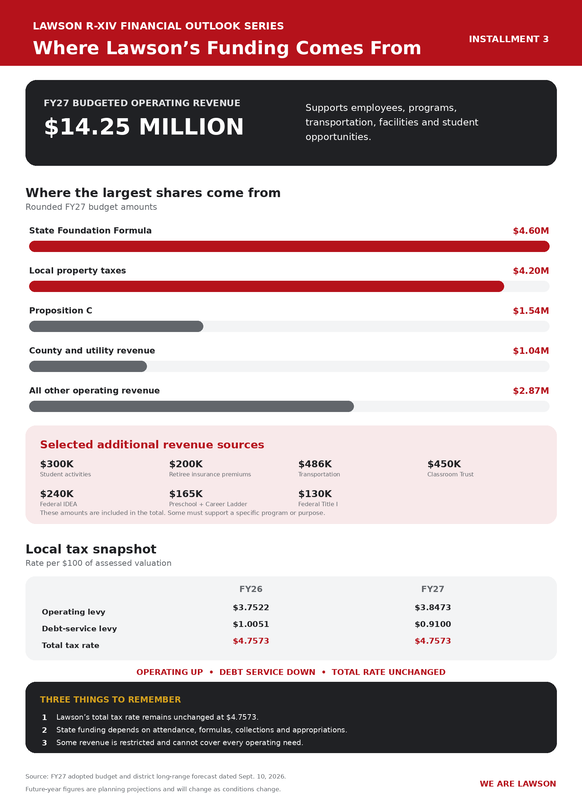
Lawson has budgeted approximately $14.25 million in operating revenue for FY27. The two largest sources are the state Foundation Formula, projected at about $4.60 million, and local property taxes, budgeted at $4.20 million. Together, those two sources provide nearly 62% of the district’s operating revenue.
Revenue source | FY27 amount | Plain-language explanation |
State Foundation Formula | $4.60 million | State formula based on attendance, student needs, and state-set factors |
Local property taxes | $4.20 million | Generated from assessed valuation and the operating levy |
Proposition C | $1.54 million | State sales-tax revenue distributed primarily on a per-pupil basis |
County and utility revenue | $1.04 million | Includes county collections and state-assessed utility revenue |
All other operating revenue | $2.87 million | Student activities, grants, transportation, federal programs and other receipts |
Local support and the tax rate
Lawson’s FY27 assessed valuation is $111,626,247. At the operating levy of $3.8473 per $100 of assessed valuation, the district would generate approximately $4.29 million at full collection. The budget uses a more conservative estimate of $4.20 million.
The operating levy increased by $0.0951, while the debt-service levy decreased by the same amount, from $1.0051 to $0.9100. Lawson’s total tax rate therefore remains unchanged at $4.7573. Installment 4 will explain why operating and debt-service dollars are kept separate.
State revenue has several moving parts
The Foundation Formula is influenced by attendance, student needs, the State Adequacy Target and other state calculations. Although Lawson’s applicable weighted attendance increased, the lower FY27 State Adequacy Target is projected to reduce formula revenue by approximately $463,000.
Proposition C is a statewide sales-tax source. Lawson budgeted approximately $1.54 million, or about 94% of the estimated entitlement, because actual statewide collections may be lower than projected.
Transportation aid also depends on state appropriations. Missouri law allows reimbursement of up to 75% of eligible costs, but the final percentage may be lower. Lawson budgeted $486,000 for FY27.
Lawson separately budgeted $450,000 from the Classroom Trust Fund. This state-calculated distribution can change with state revenue, appropriations and attendance-related calculations.
Some revenue is tied to a specific purpose
Some revenue must support a particular program. Examples include approximately $240,000 in federal IDEA funds for special education, $130,000 in federal Title funding for reading intervention, $165,000 from state preschool and Career Ladder grants, and $445,000 in food-service revenue.
The operating total also includes $300,000 connected directly to student organizations and activities and $200,000 in insurance premiums paid by retirees who continue district coverage at their own expense. These dollars pass through district accounts but are not flexible revenue for unrelated needs.
A look ahead
Lawson’s conservative forecast shows gradual revenue growth, while major sources such as the Foundation Formula and Proposition C are projected to remain relatively flat. A later installment will compare anticipated revenue with projected expenses.
The takeaway
Lawson benefits from strong local support and a healthy financial position. However, much of our revenue is determined by formulas, statewide collections or annual appropriations outside the district’s control, and some funding is limited to a particular purpose.
In the next installment, I will explain how school dollars are divided among operating, debt-service and capital-project funds—and why money available in one fund may not be used for another purpose.
Michael Stephenson
Superintendent of Schools
Lawson R-XIV School District