Installment 5: Rising Costs and the Years Ahead
Throughout this series, I have shared the progress Lawson has made, the financial foundation supporting that work, where our funding comes from, and why different dollars serve different purposes. Those decisions have helped us expand opportunities and improve facilities while maintaining strong reserves. The next question is how we sustain the instruction and services our community expects as the cost of daily operations rises.
Lawson remains financially stable. At the same time, our adopted 2026–27 budget anticipates that operating expenses will exceed operating revenue by approximately $514,000. Reduced state funding is a major reason this year's budget has shifted from recent surpluses to a planned deficit. We must continue providing strong learning opportunities and essential services for students even as that support changes. One planned deficit does not define our financial future, but repeated gaps would gradually reduce our reserves.
What is putting pressure on the operating budget
Providing quality instruction and dependable student services requires educators and support staff, transportation, utilities, insurance, supplies, and contracted services. These are the day-to-day costs of running schools. Many continue from year to year, even when the prices paid for them change.
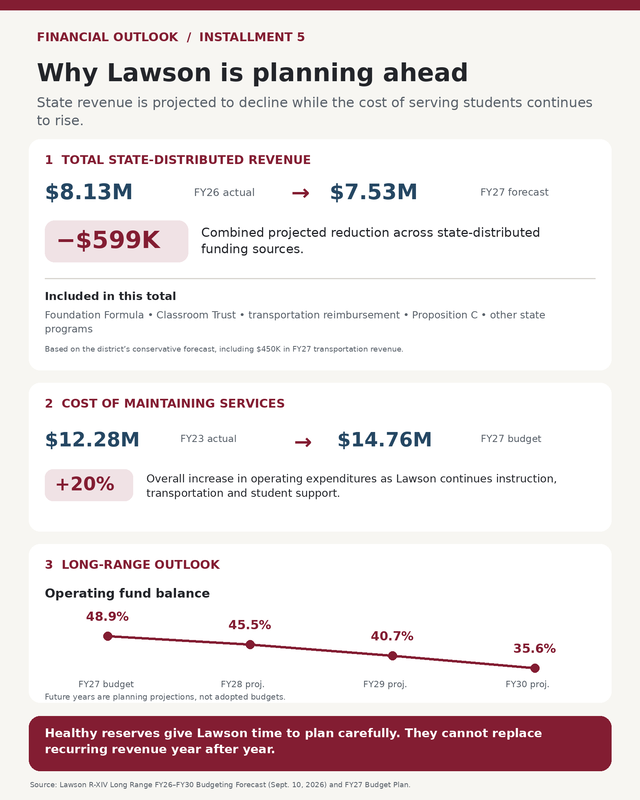
The district's conservative forecast projects approximately $7.53 million in total state-distributed revenue for FY27, down from approximately $8.13 million received in 2025–26. That is a combined decrease of about $599,000. This total includes the Foundation Formula, Classroom Trust, transportation reimbursement, Proposition C sales-tax distributions, and other state programs. A lower state-set amount used in the Foundation Formula, along with reduced Classroom Trust and transportation revenue, contributes to the decline. Lawson's applicable weighted attendance increased, yet overall state-distributed revenue is projected to fall. We must still run bus routes and provide the instruction and services students need.
What this means for Lawson: State revenue is projected to decline while Lawson maintains instruction, transportation, and student support. Reserves give us time to plan carefully, but cannot replace recurring revenue year after year.
Maintaining support as costs rise
Families expect strong instruction, safe transportation, and dependable services for students. Lawson has worked to maintain those supports while making the improvements described earlier in this series. The cost of daily operations has increased: expenditures rose from approximately $12.28 million in 2022–23 actual results to $14.76 million in the adopted 2026–27 budget, a difference of about $2.48 million, or 20%.
This change spans the people and services that make school possible. Total salary spending accounts for approximately $1.49 million of the increase; that is a districtwide spending figure, not the raise received by any individual employee. Benefits, transportation, specialized instructional services, and purchased services have also grown. Some increases reflect higher prices, while others reflect decisions to meet student needs and sustain services. Families face rising costs as well, and we recognize the importance of using community resources carefully. Many district costs recur each year, while revenue does not necessarily keep pace.
What our long-range forecast shows
The table below starts with the adopted 2026–27 operating budget. The following three years are conservative planning projections based on information available September 10, 2026. They are not adopted budgets or guaranteed results.
Fiscal year | Revenue | Expenses | Annual gap | Fund balance |
2026–27 budget | $14.25M | $14.76M | −$514K | 48.9% |
2027–28 | $14.70M | $15.07M | −$373K | 45.5% |
2028–29 | $14.80M | $15.39M | −$588K | 40.7% |
2029–30 | $14.90M | $15.61M | −$708K | 35.6% |
The forecast does not indicate an immediate financial crisis. It does show that continued annual deficits would leave Lawson with less flexibility to handle unexpected costs and future needs. Reserves give us time to respond, but they cannot permanently pay for annual expenses that exceed annual revenue.
Planning while we have choices
The adopted budget sets spending authority; it does not mean that every budgeted dollar will be spent. Actual revenue and expenses may differ from the budget, as they have in prior years. We will monitor actual revenue, staffing needs, transportation costs, and spending against the budget throughout the year. As better information becomes available, we will update the forecast and continue looking for ways to use resources efficiently while meeting students' needs.
Our goal is to preserve strong learning opportunities, support the educators and support staff who serve students, and maintain the facilities and services our community relies on. Addressing a developing gap early gives us more room to make thoughtful decisions than waiting until reserves have already fallen significantly.
Looking ahead
Lawson has made meaningful progress while building a sound financial foundation. Reduced state support, alongside the continuing cost of serving students, calls for the same careful planning that helped us reach this point. In the final installment, I will bring the series together and explain the priorities that will guide our decisions as we protect opportunities for students and sustain the district over time.
Michael Stephenson
Superintendent of Schools
Lawson R-XIV School District
Sources: Lawson R-XIV FY27 adopted budget and Long Range FY26–FY30 Budgeting Forecast dated September 10, 2026. State-distributed revenue totals compare 2025–26 actual results with the conservative FY27 forecast, including Proposition C and state program lines. The forecast assumes $450,000 in FY27 transportation reimbursement; the adopted budget uses $486,000. Future-year figures are planning projections and will be updated as conditions change.